


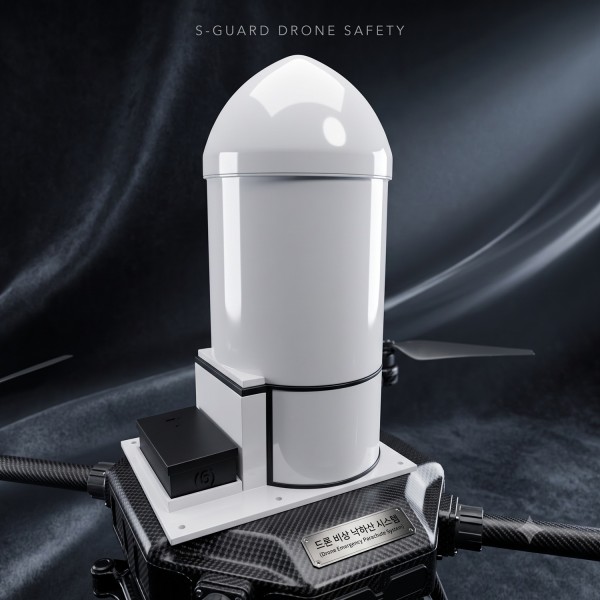
Drone Emergency Parachute Safety System

A Drone Emergency Parachute Safety System is a safety device that helps a drone land safely when it can no longer fly normally due to a malfunction, battery failure, collision, or other emergency.
If a heavy drone crashes, it can seriously injure people, damage vehicles or buildings, and even start a fire if the battery is damaged. This system is designed to reduce these risks by deploying an emergency parachute and allowing the drone to descend safely.
Emergency Parachute Launch System
The parachute is deployed using compressed gas (high-pressure gas stored inside a cylinder).
When activated, the gas is released instantly, creating enough force to launch the parachute quickly and safely away from the drone.
The launcher includes an igniter (a device that releases the gas) and a gas cylinder (a container that stores high-pressure gas) in one compact unit. This simple design makes the system reliable and easy to maintain.
A pressure sensor (a sensor that checks the gas pressure) is installed inside the cylinder. It continuously monitors the gas pressure so the user can make sure the system is always ready for use.
The gas pressure can be checked in two ways:
- Directly through the built-in monitoring system.
- By using the Pilot Safety Inspection App on a smartphone.
Before every flight, users can perform both a first and second safety inspection. The inspection records are saved and can be used later for accident analysis or insurance claims.
Automatic Emergency Sensor System
The system includes an Automatic Emergency Sensor (a smart device that monitors the drone during flight).
It constantly checks the drone's condition using several sensors:
- GPS (Global Positioning System) – checks the drone's location and speed.
- Gyroscope (sensor that measures tilt and rotation) – detects abnormal flight attitude.
- Barometric Sensor (air pressure sensor) – measures altitude.
- Accelerometer (motion and impact sensor) – detects sudden movement or free fall.
- Pressure Sensor – monitors the compressed gas pressure.
By combining all of this information, the system can monitor the drone in real time, just like the drone's own flight controller.
Emergency Backup Battery
The system also has a built-in Backup Battery (an emergency power source).
If the drone completely loses power because of a battery failure or electrical problem, the backup battery automatically powers the emergency parachute system.
Even when the main battery stops working, the parachute can still be deployed to help protect people and property on the ground.
Four Ways to Deploy the Parachute
The emergency parachute can be activated in four different ways.
1. Automatic Signal from the Flight Controller
The Flight Controller (the drone's main computer) detects a serious problem and automatically sends a launch signal.
2. Independent Sensor Activation
If the flight controller cannot send a signal, the Automatic Emergency Sensor analyzes the flight data by itself.
If it detects an emergency, it deploys the parachute automatically.
3. Total Power Failure
If all power and communication are lost, the Backup Battery activates the parachute system automatically.
4. Manual Pilot Activation
The pilot can deploy the parachute at any time using the Remote Controller (the handheld controller used to fly the drone) whenever an emergency is recognized.
Built-in Black Box
The system also works as a Black Box (a device that records accident information).
As soon as the parachute is deployed, the built-in camera starts recording video and continues recording until the backup battery is exhausted.
During the descent, the system also activates:
- High-Brightness Warning Lights (bright LED lights) to make the drone easy to see.
- Warning Sound (an audible alarm) to alert nearby people and help prevent secondary accidents.
These recorded videos can be useful for accident investigations and insurance claims.
Product Design
Launch Cap
The Launch Cap (the top cover of the launcher) is designed with an aerodynamic shape (a shape that reduces air resistance) so it has very little effect on the drone's flight performance.
Inside the cap, the parachute canopy (the fabric of the parachute) is safely protected until deployment.
Special guide grooves are included for the Risers (the straps connecting the parachute to the drone).
The cap also features:
- Splash-resistant protection (helps keep out rain during normal flight)
- A secure locking structure that prevents accidental opening
- A sealed design that maintains the proper launch pressure
Launch Tube
The Launch Tube (the main tube that launches the parachute) contains:
- An integrated igniter
- A compressed gas cylinder
The tube also includes:
- A launch guide slot to improve deployment performance
- A support plate to increase launch efficiency
Two connection ports allow the launcher to be securely connected to the drone.
Modular Design
The launcher uses a Modular Design (easy to install and remove).
It can be installed on both existing drones and newly designed drones.
For existing drones, a mounting bracket can be attached easily.
For new drone designs, manufacturers only need to include a standard mounting area, allowing the safety system to be installed whenever the customer chooses.
Optional Safety Equipment
The Drone Emergency Parachute Safety System is designed as an optional safety upgrade.
Drone manufacturers can provide a standard mounting location, while customers decide whether they want to purchase and install the parachute system.
This approach offers several advantages:
- Users can choose additional safety when needed.
- Drone manufacturers can offer the system as an optional accessory.
- Manufacturers gain an additional source of revenue.
- Installation is simple and does not require major changes to the drone design.
